

The short answer is, yes, doing specific exercises can improve osteoporosis management by building bone strength, enhancing balance, and reducing the risk of falls. However, it can’t fully reverse bone loss that has already occurred, but according to Healthy Bones Australia, targeted physical activity reduces pain and helps maintain your mobility
Can Exercise Improve Osteoporosis?
Osteoporosis causes bones to become weak and brittle, occurring as a result of ageing and your bones losing the ability to repair and reform themselves. Exercise helps to manage osteoporosis by slowing the rate of bone loss, increasing bone density and improving muscle strength.
The key is to start before things are too far gone, because as they say, use it or you’ll lose it. If you don’t place load on your body, your bones will slowly reduce in density, to the point where they become so weak that they can break with minimal force and from things as simple as minor falls or impacts.
How Exercise Affects Bone Density
Exercise helps bone density because as Wolff’s Law states: Bones adapt to the physical forces placed upon them. So, when you subject your body to gravity, impact, or resistance, the bone tissue bends or responds at the microscopic level. This physical strain of impact or resistance prompts bone-building cells called osteoblasts to deposit new mineral material onto the bone matrix, building stronger bones.
Another outcome of exercise is that rapid impacts, such as running, or heavy loads, like lifting weights, moves fluid through tiny channels inside your bones, which further stimulates bone growth. However, if you already have osteoporosis, this should only be done under supervision and if prescribed by an experienced health practitioner.
Best Types of Exercise for Osteoporosis
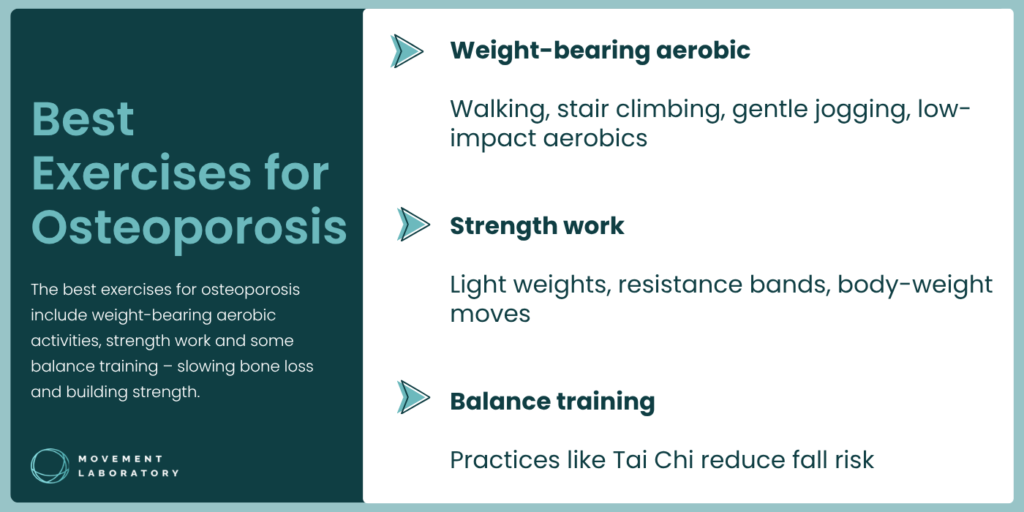
The best exercises for osteoporosis include weight-bearing aerobic activities, strength work and some balance training.
Walking, stair climbing, very gentle jogging (Once you’ve done a few weeks of walking) and low-impact aerobics put safe, moderate pressure on the bones, and if done regularly is often adequate to maintain bone density.
Other good additions are lifting light weights, using resistance bands, or doing body-weight exercises like wall push-ups, unweighted half squats and half lunges. These movements pull on the bones to keep them strong, while increasing muscle mass and improving cardiovascular health – which amongst other things can aid in balance. Regarding balance, movements found in practices like Tai Chi can help keep you steady on your feet and reduce the risk of a fall.
The main things to note regarding all of the above exercises is to start very easy and ideally with some form of expert guidance. Never exert yourself too much, instead keep things at a level where you can still have a conversation while exercising. Also, try to do some form of exercise on a daily basis, and if possible, do a variety of activities across the week so you are exposing your bones to different stresses.
Exercises to Avoid With Osteoporosis
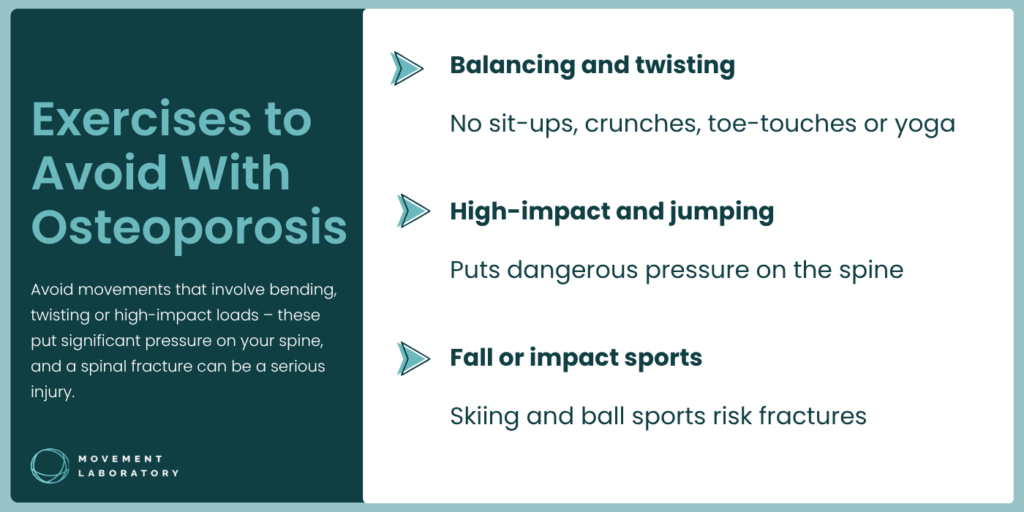
The types of exercises to avoid with osteoporosis are those that involve bending and twisting, or high impact loads. It’s best not to do sit-ups, crunches, forward bending to touch your toes, yoga and jumping movements. These movements all put significant pressure on your spine, and a spinal fracture can be a very significant injury that leaves you immobile for an extended period, further increasing the effects of osteoporosis.
Fall risk or impact sports, such as skiing or ball sports, should also be avoided as they increase your chances of a stumble or trip that can cause a fracture or bone breakage. Also, when going to the gym to do weights, firstly, don’t use a barbell across your shoulders for squats, instead use dumbbells. Secondly, avoid exercises that involve fast movements, rotation or large ranges of motion.
Is High-Intensity Exercise Safe if You Have Osteoporosis?
Yes, high-intensity exercise is safe if you have osteoporosis, but only if it is supervised, progressive and done after a thorough fracture risk has been conducted.
Clinical trials have shown that high-intensity resistance and impact training may improve bone density, particularly in the spine and hips, without increasing fracture rates, provided proper technique is used. The most important thing to note is that this type of activity needs to be added very slowly and over an extended period to allow the body to adapt and for you to learn the proper technique. This should always be done under the guidance of an experienced practitioner.
How to Get Started Safely
If you have osteoporosis, when starting an exercise program you should always first consult your doctor for their guidance. Next, seek an experienced practitioner, such as a physiotherapist who can assess what movements are safe and beneficial for you. The progression from here will be to slowly ease into the recommended exercise regime, with careful monitoring to ensure proper technique and safe levels of activity. Over time and by working with the same practitioner consistently, you will be able to gradually increase the workload and therefore get better results.